
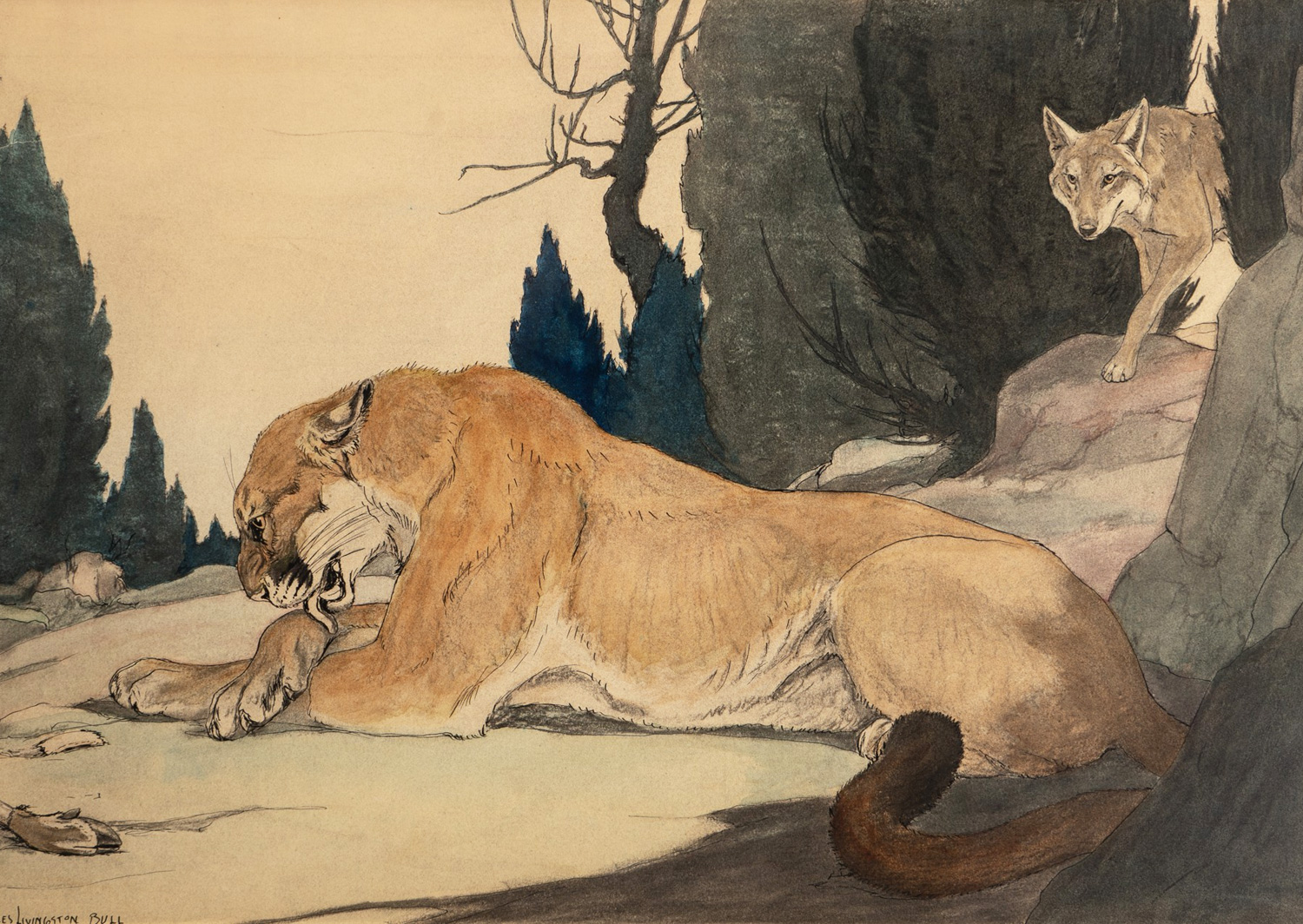
Charles Livingston Bull may have worked more than a century ago, but his art still feels alive today. Known as one of America’s foremost wildlife illustrators, Bull had a rare gift for capturing the spirit of the animals he drew. His work wasn’t just about accuracy—though he had that in spades—it was about movement, design, and emotion.
As a wildlife artist, I’m drawn to Bull because his art reflects so many of the things I strive for in my own work: a reverence for nature, a strong sense of design, and the ability to make a creature feel like it might leap off the page. In this post, I’ll explore his story, highlight what made his art so distinctive, and share how his legacy continues to inform my own creative process today.
Charles Livingston Bull was born in 1874 in rural New York. From an early age, he showed two passions: a love for wildlife and a talent for drawing. What set Bull apart from other artists of his time was how deeply he studied the animals he drew. Before he became known as an illustrator, he trained as a taxidermist.
This early career gave him an intimate understanding of animal anatomy. Working at the National Museum in Washington, D.C., he spent years preparing specimens and learning every muscle, feather, and bone. He also took evening art classes at the Corcoran Gallery. That unusual combination—science by day, art by night—gave Bull a foundation few artists had. When he transitioned to illustration, he brought not only keen observation but a deep biological knowledge that made his animals feel startlingly real.
Bull moved to New York City to pursue illustration full time, and his career took off quickly. He became a frequent contributor to The Saturday Evening Post, one of the most widely read magazines of the early 1900s. Over his career, he illustrated more than 125 books and painted 19 covers for the Post. One of his early successes was contributing imagery for Jack London’s The Call of the Wild when it was serialized in 1903. The work showcased the qualities that would define his career: anatomical accuracy, palpable motion, and strong design.
By the time of his death in 1932, Bull had produced thousands of illustrations for books, magazines, and posters. He was widely regarded as the premier wildlife artist of his day—a title earned through both prolific output and a distinctive, enduring style.
While Bull’s anatomical knowledge gave his work realism, it was his design sense that made it truly memorable. He wasn’t just drawing animals—he was composing graphic statements. Bull was influenced by Art Nouveau and Japanese woodblock prints, and you can see those influences in his flowing lines, bold silhouettes, and confident use of flat shapes to create clarity and impact.
One of his trademarks was dynamic composition. He often cropped images in unexpected ways—cutting off a wingtip or the edge of a paw—to create immediacy and momentum. Rather than presenting a static tableau, he made you feel as though you were witnessing a moment: a hawk mid-dive, a wolf running full tilt, a tiger suspended in the apex of a leap. The action reads instantly, yet the design remains balanced and deliberate.
Consider his well-known circus poster of a leaping tiger for Ringling Bros. The image is deceptively simple—just the tiger, coiled and airborne—but the energy is electric. The negative space around the animal heightens the tension, while the strong contour lines control the viewer’s eye from head to tail. His Saturday Evening Post covers operate similarly: birds in flight, bears in motion, and cougars on the move, all constructed with clear silhouettes and strong directional rhythms that guide attention exactly where he wants it.
That balance of accuracy, energy, and design is what makes Bull’s work feel surprisingly modern. As I plan a piece—especially one with strong gesture or movement—I often reference the underlying logic of his compositions. How does the line of action anchor the scene? Where does negative space provide breath? Which shapes carry the weight of the design, and which details are best simplified? Bull’s images offer a masterclass in deciding what to emphasize and what to let go.
Beyond his technical skill, I connect with Bull because of the values behind his work. He clearly loved the animals he drew. At a time when wildlife was often depicted as trophies or background scenery, Bull portrayed his subjects with dignity and vitality. His images helped audiences see wolves, bears, and raptors not just as symbols or quarry but as living beings worth respecting.
In this way, he was ahead of his time. The conservation movement was just beginning in the early 1900s, yet Bull’s illustrations quietly encouraged people to appreciate and protect the natural world. He even kept a small menagerie at his New Jersey home—peacocks, ducks, deer—because he loved being close to the creatures he studied. That proximity translates into art that feels empathetic rather than detached, celebratory rather than clinical.
His community spirit also resonates with me. In 1911, he helped found one of the first Boy Scout troops in New Jersey, sharing outdoor skills and a love of nature with young people. That impulse to mentor, to pass along wonder and craft, is something I try to embody as well—whether through behind-the-scenes glimpses of my process, studio conversations, or simply making work that invites viewers to slow down and look closely.
Creatively, I’m aligned with Bull’s pursuit of motion and emotion. When I paint or sculpt wildlife, I’m hunting for that charged instant: a bear pausing mid-step, a heron lifting from the water, the glance that reveals character. Anatomy matters, but it’s the feeling—the posture, the gesture, the line of energy—that brings an animal to life. Bull’s example reinforces a simple, demanding truth: strong design is not decorative; it’s the structure that carries the life of the image.
More than a century after their creation, Charles Livingston Bull’s illustrations can still stop you in your tracks. His mastery of composition, his reverence for wildlife, and his willingness to share that passion beyond the studio make him a lasting inspiration. Studying his work reminds me to be bold in layout, intentional in simplification, and uncompromising about the line of action that animates a piece.
Whether it’s a painting of a bear in the Smokies or a sculpture capturing the quiet concentration of a bird at rest, I want my work to carry forward some of that same spirit—images that first read as strong designs, then unfold into living moments. That’s the lesson I take from Bull: design and life are not competing priorities; they are partners in making the wild feel present.
Fresh Updates from the Studio